





Most of us are interested in learning more about drawing techniques and expanding our abilities beyond Zentangles. Here Guest Contributor Sandra Strait offers an excellent tutorial showing how to make an object appear translucent using pen and ink.

Sandra Strait
Shading for Translucence
Oddly enough, shading can imply light as well as shadow. The method I’m showing here can be used to imply dark glass, or eyes.
Translucence versus Transparency
A truly transparent object is clear, and you don’t see it all. For instance, you don’t see a clean window. A semi-transparent object seems ghostly, like a bubble. You see highlights, color and shadow, but you also see what is behind it.
A translucent object, such as darkly colored glass, is transparent enough to allow light to shine through, but you can’t see what is behind it.
In this example, the object on the left is semi-transparent, and the object on the right is translucent.
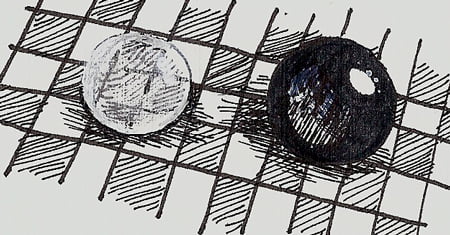 Semi-transparency is more difficult, and I might tackle it another day.
Light Source
If you’ve studied drawing at all, you’ve seen advice about locating your light source. Don’t worry about it for tangling. That’s all you need to know on this subject, lol.
The Steps
The shapes don’t need to be exact. A roughly triangular or kidney bean shape works well. The shaded area should be approximately twice as large as the white spot.
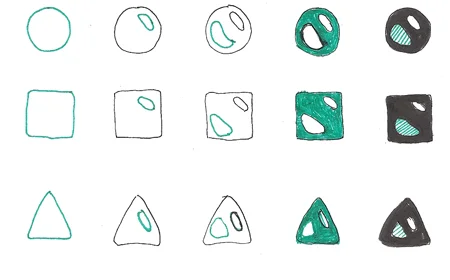 You can shade with a pencil, but I recommend drawing lines, because then you can choose how much light seems to show through. The closer and darker the lines, the less light. The fewer and lighter the lines, the more light is shining through.
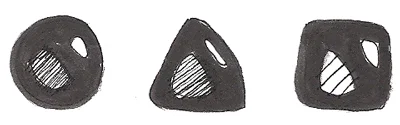
You can get various effects by changing the way you shade. In the example below, I shaded with a silver Sakura Gelly Roll Metallic Pen

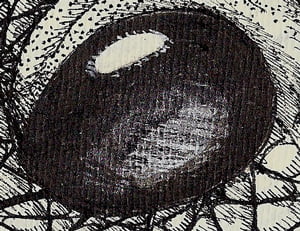
Shading for translucence is easy enough to do, but produces a very elegant effect.
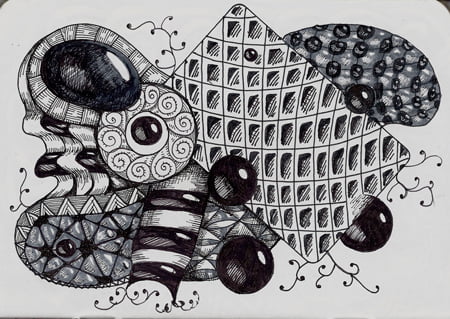
Sandra’s Zentangle-inspired art entitled “Waffle World” featuring her translucence technique. Copyright the artist, used with permission.
|
.oOo. |
|
Enhance your Zentangle experience while supporting TanglePatterns: |
|
BRAND NEW! TanglePatterns.com TANGLE GUIDE, 2026 Edition |
|
 |
The 15th Edition of the TanglePatterns.com TANGLE GUIDE is an instant-download 123-page interactive digital eBook/PDF containing over 2,300 tangles on the site from May 2010 through December 31, 2025. It's a great resource and a must-have digital tool for using the site. Visit the STORE > E-BOOKS page and help keep TanglePatterns.com going by getting your copy now! |
|
"Linda, Thank you! I was relying on too few and getting stuck after 3 years of daily working with Zentangle. This has inspired me to ‘begin again’ with renewed excitement." ~ Barbara R. |
|
| See the BOOK REVIEWS page for more details on its features and view a sample page. Note: this is a digital product downloaded immediately when ordering, nothing will be physically mailed to you. | |
| If you're new to Zentangle® and tangling, my TanglePatterns.com BEGINNER'S GUIDE TO ZENTANGLE is just what you need to get started. Also available en Français and en Español. | |
|
|
|
 |
This is the only Zentangle book you'll ever need: the fabulous Zentangle PRIMER Vol 1. It's your CZT-in-a-book by the founders of Zentangle®. For more about the content and to read the rave reviews, visit the BOOK REVIEWS tab. |
| Available in KINDLE format for $9.99. Spanish Edition here. Japanese Edition here. | |
| "Absolutely the best Zentangle Book yet! As an accomplished artist I used to think I did not need instruction on this art form. How wrong I was! My tangling improved by leaps and bounds after reading this book. If you think you have Zentangle down then you need this book more than ever!" ~ Kris H | |
|
|
|
|
.oOo. |
|
 May 7, 2011 |
  More like this:
Excellent! This is exactly what I’ve been trying to figure out without much luck on my own. Thank you Sandra for sharing and Linda for posting! Love the tip about don’t worry with the direction of light for tangling… what a relief. I can never get it right. 🙂
Sandy, this is wonderful. Thanks so much for sharing!
Very good lesson, provided here. It was quite clear!
Thank you for posting this Linda. I know the most people will see it because everyone visits your website!
Thank you also for explaining the difference between translucent and transparent. I found that if I heard the word translucent I mentally pictured transparent….. no wonder I got confused. LOL
Thank you Sandra and Linda. I have learned more about drawing since i discovered tangling in januari then I did ever before; This is a great help .
Excellent lesson, I will use this, thanks.
Terrific article Sandra! Clear and concise and nicely illustrated. I often use one highlight on things, but will now try using two on occasion! Thanks.
Great tutorial. Thanks Sandra (and Linda)!