



 What Makes a Zentangle® Tangle?
Thinking about submitting a pattern to TanglePatterns.com? This article explains the principles that guide my review process and the qualities commonly found in successful Zentangle tangles.
Click for article in French, Spanish, Japanese.
.oOo.
One of the questions I hear most often from pattern creators is: What makes a pattern a tangle?
It’s a good question. Many creative patterns are submitted to TanglePatterns.com every year, and while they may be beautiful, interesting, and enjoyable to draw, not all of them function as tangles within the Zentangle Method.
This article explains some of the qualities I consider when reviewing submissions and, more importantly, the principles established by Zentangle founders Maria Thomas and Rick Roberts.
This article is not intended as a checklist for acceptance. Rather, it’s an overview of the principles that guide my review process and the qualities commonly found in successful Zentangle tangles.
There Is No Official Definition of a Tangle
There is no official rulebook that defines exactly what is or is not a tangle. However, Zentangle co-founder Maria Thomas has often described the qualities that make a pattern work successfully as a tangle within the Zentangle Method.
The ideas on this page are drawn from those teachings and from years of observing and deconstructing tangles for TanglePatterns. They are not intended as rigid rules, but as practical guidelines for evaluating whether a pattern is likely to be useful, teachable, and adaptable within the Zentangle tradition.
A Tangle Is a Pattern, Not a Picture
At its heart, a tangle is a non-representational pattern built from repeating elements.
The distinction may sound simple, but it’s important. A tangle is not created by repeating a recognizable object over and over. Rather, it is created by repeating strokes, shapes, and structural components that work together to form a pattern.
In the IDOZ 2025 video, Maria Thomas points out that if the strokes themselves don’t repeat, you’re drawing rather than tangling.
This is often the most challenging concept for new pattern creators. The goal is not to invent something to draw; the goal is to discover a pattern that emerges from repeating simple elements.
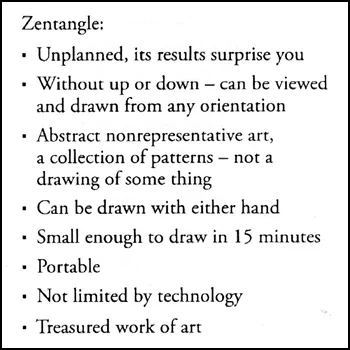
From the “Beginning Zentangle” booklet in the Official Kit
Keep It Non-Representational
An important principle of the Zentangle Method™ is that tangles are non-representational.
As stated in The Book of Zentangle:
“Keep it Non-representational. Zentangle artwork is intended to be non-representational. Zentangle’s elemental strokes are also non-representational. We don’t teach complex elements such as hearts, stars or flowers. Tangles are also non-representational.”
For this reason, patterns based primarily on recognizable objects, symbols, or motifs — such as flowers, hearts, stars, animals, letters, or similar forms — generally fall outside the traditional Zentangle understanding of a tangle.
Also, tangles never begin with pencil planning. A tangle should be simple enough to draw directly in ink, without pencil guidelines, pre-printed grids, erased lines, underlying construction marks or using tools like stencils. Inked dots or grids may be part of some tangles.
This does not mean such patterns lack creativity, beauty, or artistic merit. They simply serve a different purpose than a Zentangle tangle.
Simplicity Is a Feature, Not a Limitation
Many creators naturally focus on originality. While originality is certainly appreciated, the most successful tangles are rarely the most complicated.
Maria and Rick describe tangles as being “magical, simple and easy to create.”
The challenge is not merely to invent something new. The challenge is to create a pattern that remains elegant while being easy to remember, easy to teach, and accessible to tanglers of all ages and skill levels.
A useful question is: Can someone else learn this pattern from a clear step-by-step deconstruction and successfully recreate it on their own?
Simple tangles often reveal surprising depth when repeated, combined, varied, and explored.
Tangles Begin Directly in Ink
A tangle should be simple enough to draw directly in ink, without pencil planning. It should not depend on pencil guidelines, pre-printed grids, erased lines, underlying construction marks, or tools such as stencils.
Inked dots or grids may be intentional, visible parts of some tangles. The distinction is that they belong to the finished pattern rather than serving as hidden planning or construction marks.
The Best Tangles Invite Success
One of the strengths of the Zentangle Method is that it offers a high degree of success to virtually anyone willing to put pen to paper.
When evaluating a new tangle, I consider:
- Is it easy to learn?
- Can it be remembered without constantly referring to instructions?
- Does it rely on repeating simple strokes?
- Can it be taught clearly through a deconstruction?
- Does it encourage exploration and variation?
- Does it feel more like tangling than drawing?
Patterns that satisfy these qualities tend to have lasting value within the Zentangle community.
Before You Submit
If you’re considering submitting a pattern to TanglePatterns.com, ask yourself:
- Is it non-representational?
- Are the strokes and structures repeating?
- Is it a genuine pattern rather than a repeated object?
- Is it simple enough to teach?
- Can it be explained through a clear deconstruction?
- Does it align with the principles of the Zentangle Method?
These questions can help you evaluate whether a pattern is likely to function successfully as a Zentangle tangle. However, meeting these criteria does not guarantee publication.
Publication decisions also involve considerations such as variety, timing, similarity to existing tangles, instructional clarity, and the overall balance of patterns already represented on the site.
Not every beautiful pattern is a tangle, and many patterns exist somewhere between drawing and tangling. That’s perfectly okay.
If, after reading this article, you discover that your design may not yet function well as a tangle, don’t be discouraged. Many artists develop their strongest tangles through experimentation, simplification, and refinement of an initial idea.
The process of observation, exploration, and discovery is part of the Zentangle spirit. Every new pattern is an opportunity to learn something new.
My goal is to curate patterns that reflect the spirit and principles of the Zentangle Method while helping preserve and expand the rich, evolving language of tangles.
Thank you to everyone who experiments, explores, and contributes to this creative community. Your curiosity and creativity help keep the art of tangling vibrant and growing.
How to Submit Your Pattern
Here’s a guide/checklist on how to prepare your submission and send it to me for publication consideration.
|
.oOo. |
|
Enhance your Zentangle experience while supporting TanglePatterns: |
|
BRAND NEW! TanglePatterns.com TANGLE GUIDE, 2026 Edition |
|
 |
The 15th Edition of the TanglePatterns.com TANGLE GUIDE is an instant-download 123-page interactive digital eBook/PDF containing over 2,300 tangles on the site from May 2010 through December 31, 2025. It's a great resource and a must-have digital tool for using the site. Visit the STORE > E-BOOKS page and help keep TanglePatterns.com going by getting your copy now! |
|
"Linda, Thank you! I was relying on too few and getting stuck after 3 years of daily working with Zentangle. This has inspired me to ‘begin again’ with renewed excitement." ~ Barbara R. |
|
| See the BOOK REVIEWS page for more details on its features and view a sample page. Note: this is a digital product downloaded immediately when ordering, nothing will be physically mailed to you. | |
| If you're new to Zentangle® and tangling, my TanglePatterns.com BEGINNER'S GUIDE TO ZENTANGLE is just what you need to get started. Also available en Français and en Español. | |
|
|
|
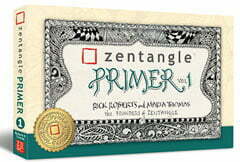 |
This is the only Zentangle book you'll ever need: the fabulous Zentangle PRIMER Vol 1. It's your CZT-in-a-book by the founders of Zentangle®. For more about the content and to read the rave reviews, visit the BOOK REVIEWS tab. |
| Available in KINDLE format for $9.99. Spanish Edition here. Japanese Edition here. | |
| "Absolutely the best Zentangle Book yet! As an accomplished artist I used to think I did not need instruction on this art form. How wrong I was! My tangling improved by leaps and bounds after reading this book. If you think you have Zentangle down then you need this book more than ever!" ~ Kris H | |
|
|
|
|
.oOo. |
|
RECENT COMMENTS