



 What is a tangle?
In Zentangle®, not every pattern is a tangle.
A tangle is an abstract, non-representational pattern made from simple, repeated strokes. It grows one stroke at a time, without pencil planning, rulers, stencils, erased lines, or a predetermined result.
That simplicity is not a limitation — it is the point.
The Zentangle Method™ was designed to remove the thinking, planning, judging, and decision-making that so often get in the way of creativity. When we are not trying to draw a recognizable object, copy an image, or make something “come out right,” we are free to focus on the next stroke.
This is why tangles are generally not drawings of flowers, leaves, animals, hearts, stars, objects, figures, scenes, lettering, or other recognizable images. Those may be lovely patterns, illustrations, motifs, doodles, or Zentangle-inspired art — but they are not necessarily tangles.
As Rick Roberts and Maria Thomas explain in The Book of Zentangle, tangles are non-representational. Even their names usually have little relationship to what the tangle looks like, so they do not create a preconception of what the result “should” be.
That is the heart of the Zentangle experience: abstract, structured pattern-making that grows organically, one simple stroke at a time.
What makes a pattern a tangle?
After becoming a Certified Zentangle Teacher in October 2011, I had the opportunity to spend time with Maria Thomas discussing what makes a tangle — and what does not.
Maria has written that, in Zentangle, “a pattern is not always a tangle.” Tangles are magical, simple, and easy to create. They should be easy to teach and offer a high degree of success to tanglers of all ages.
Complex patterns may be beautiful, but if they require too much planning, counting, measuring, penciling, erasing, or careful construction, they can pull us out of the relaxed rhythm of Zentangle.
Simple tangles are the Zen of Zentangle.
Characteristics of a tangle
A tangle generally has these characteristics:
- It is abstract and non-representational.
A tangle does not depict a recognizable object, figure, scene, symbol, flower, animal, letter, or picture. - It is made from simple, repeated strokes.
Zentangle is about the repetition of a stroke, not the repetition of a drawing. - It has no right-side-up.
A tangle is usually non-directional. It can be turned and viewed from any orientation. - It grows organically.
A tangle usually develops across an area rather than existing as a single isolated motif. - It is built from elemental strokes.
Most tangles use only one, two, or three simple elemental strokes: a dot, a straight-ish line, a curve, an S-curve, or an orb. - It does not begin with pencil planning.
A tangle should be simple enough to draw directly in ink, without pencil guidelines, pre-printed grids, erased lines, or underlying construction marks. Inked dots or grids may be part of some tangles. - It does not require tools to construct.
Rulers, stencils, templates, compasses, digital aids, or other mechanical guides are not part of the tangle itself. - It is simple enough to teach.
A tangle should be deconstructable into clear steps that another person can follow successfully. - It invites variation.
A good tangle does not depend on being copied exactly. It leaves room for each tangler’s hand, rhythm, and personal expression. - It feels elegant and original.
A tangle may remind us of something familiar, but it should not simply be a copied decorative pattern, symbol, logo, textile motif, clip art design, or existing artwork.
What if my pattern is not a tangle?
That does not mean it has no value.
There are many wonderful kinds of patterns, designs, motifs, illustrations, borders, mandalas, doodles, and Zentangle-inspired art. They can be creative, beautiful, meaningful, and enjoyable to draw.
They simply may not meet the specific definition of a tangle for TanglePatterns.com.
This distinction is not meant to discourage anyone. It helps preserve the unique qualities of the Zentangle Method: simplicity, abstraction, repetition, ease of learning, and the calm that comes from drawing one stroke at a time.
Submitting a pattern to TanglePatterns
If you have deconstructed the steps for an original pattern that meets the characteristics of a tangle, you are welcome to review the submission guidelines under the SUBMIT YOUR PATTERN tab.
Before submitting, please take a moment to ask:
- Is it abstract and non-representational?
- Can it be drawn without pencil planning, rulers, stencils, or erasing?
- Is it made from simple repeated strokes?
- Does it grow organically rather than repeat a single drawing?
- Can someone else learn it easily from the steps?
- Is it original, not copied or adapted from another source?
If the answer is yes, it may be a good candidate for TanglePatterns.
If not, enjoy it for what it is — a pattern, motif, drawing, or piece of Zentangle-inspired art — and keep exploring. Often, by simplifying an idea down to its most basic repeated strokes, you may discover the tangle hidden within it.
Related Links
- The Importance of Strings – as important to the Zentangle Method as the tangles themselves, Strings provide structure for our Zentangles
- Un motif n’est pas toujours un tangle
- Un diseño no es siempre un tangle
|
.oOo. |
|
Enhance your Zentangle experience while supporting TanglePatterns: |
|
BRAND NEW! TanglePatterns.com TANGLE GUIDE, 2026 Edition |
|
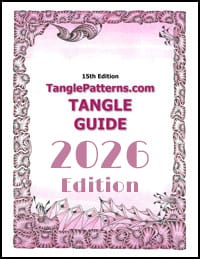 |
The 15th Edition of the TanglePatterns.com TANGLE GUIDE is an instant-download 123-page interactive digital eBook/PDF containing over 2,300 tangles on the site from May 2010 through December 31, 2025. It's a great resource and a must-have digital tool for using the site. Visit the STORE > E-BOOKS page and help keep TanglePatterns.com going by getting your copy now! |
|
"Linda, Thank you! I was relying on too few and getting stuck after 3 years of daily working with Zentangle. This has inspired me to ‘begin again’ with renewed excitement." ~ Barbara R. |
|
| See the BOOK REVIEWS page for more details on its features and view a sample page. Note: this is a digital product downloaded immediately when ordering, nothing will be physically mailed to you. | |
| If you're new to Zentangle® and tangling, my TanglePatterns.com BEGINNER'S GUIDE TO ZENTANGLE is just what you need to get started. Also available en Français and en Español. | |
|
|
|
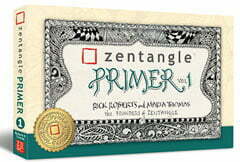 |
This is the only Zentangle book you'll ever need: the fabulous Zentangle PRIMER Vol 1. It's your CZT-in-a-book by the founders of Zentangle®. For more about the content and to read the rave reviews, visit the BOOK REVIEWS tab. |
| Available in KINDLE format for $9.99. Spanish Edition here. Japanese Edition here. | |
| "Absolutely the best Zentangle Book yet! As an accomplished artist I used to think I did not need instruction on this art form. How wrong I was! My tangling improved by leaps and bounds after reading this book. If you think you have Zentangle down then you need this book more than ever!" ~ Kris H | |
|
|
|
|
.oOo. |
|
RECENT COMMENTS